
Very polite gentlemen, professional and got the job done to a great standard in impressive time
A full EV battery every morning,
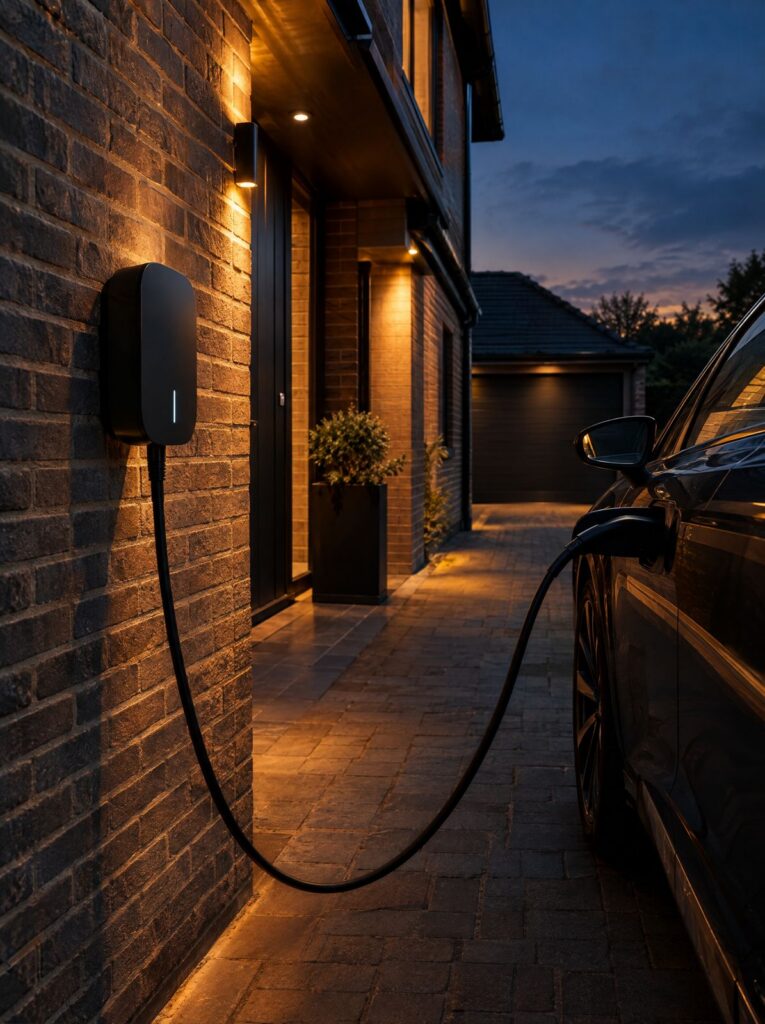
A home charger turns your driveway into the cheapest place you will ever fill up. Set it to run on your overnight rate, or on the surplus from your own panels, and the car looks after itself.

Start your quote
Get a charger quote
for your driveway
What a charger costs depends on your electricity supply, where you park and how far the cable has to run — so a few questions up front save a wasted visit and get you a price that holds.
Two Ways In
Charging for the driveway
and for the car park
A single charger on a house and a bank of them on a commercial site are different jobs with different paperwork. We do both, and the survey starts the same way either way — with your electricity supply.
Typically half a day on site, start to finish.
Also worth pairing with commercial solar on the same roof.
That’s the first thing we check, and it’s free.
Why DW Solar
Why drivers choose us for their charger
Most charger quotes are a price for a box on a wall. The box is the easy part. What matters is whether your supply can carry the load alongside everything else in the house, how the unit is earthed, and where the cable runs — and that is electrical work, not a fitting job.
THE BENEFITS
What a home charger
changes day to day
Free survey, written quote, no obligation.
What Our Customers Say
We’ve been using DW Solar for our installs for many years!
Always reliable, always outstanding work and a great bunch of people to work with!
5* Service all round
Very smooth process from the initial contact to the scaffolding and installation, The installation was completed within a day and we was saving money instantly. I would recommend this company for solar panels and battery storage
Very tidy solar installation
By the team. Thank you.
Chargers we fit






HOW IT WORKS
From survey to switch-on
in five steps
Step one takes about an hour, and there’s nothing to pay.
Questions
EV charging FAQs
The questions we’re asked most often on charger surveys. If yours isn’t here, ask us directly — we’d rather you had the full picture before deciding.
Want a charger on your driveway?
Free survey and written quote, with no obligation.
Most homes have a single-phase supply, which means a 7kW charger. That adds roughly 25 to 30 miles of range an hour for a typical car — enough to go from nearly empty to full overnight.
Your car sets the ceiling as much as the charger does: some models can only accept a lower rate on AC, so a faster unit would make no difference. We’ll check yours before recommending anything.
Almost certainly not. Three-phase allows a 22kW charger, but very few homes have it and most cars can’t use the full rate anyway. It’s far more relevant on commercial sites with several units.
If you do have three-phase, we’ll tell you at the survey whether it’s worth using.
Yes, with a charger designed for it. Those units watch what your panels are exporting and divert the surplus into the car instead, either topping up with grid power or waiting until there’s enough sun, depending on the mode you choose.
It needs a compatible charger and a sensor at your meter, so it’s worth deciding before you pick the unit rather than after.
Yes. EV chargers have to be notified to your regional network operator, and we handle that as part of the job. You don’t usually need planning permission for a standard home installation.
If you rent, or live in a flat or a managed block, you’ll need the landlord’s or freeholder’s permission before we can start.
There are government grants for some situations — people who rent or own a flat, and businesses installing chargers at a workplace. Homeowners in houses have not been eligible for several years.
Grant-funded installations must be carried out by an installer authorised under the relevant scheme. Ask us and we’ll tell you honestly whether your situation qualifies and whether we can do it.
Most home installations are done in half a day. Longer cable runs, an outbuilding, a consumer unit change or anything involving trenching will take longer, and we’ll tell you that in the quote rather than on the day.
It’s usually still doable. We run a suitably sized cable to a detached garage, a carport or the far end of a driveway, and where that means going under a path or a lawn we’ll price the groundwork in the quote.
The longer the run, the more the cable size matters — undersized cable is a common corner-cut and it costs you charging speed.
It depends on how you park and what else you have. A tethered unit with its own cable is quicker day to day; an untethered socket is tidier and handles different cars. If you have solar, you want a unit that can divert surplus.
We fit several brands rather than pushing one, and we’ll explain the trade-offs at the survey instead of steering you to whatever we have in the van.
Stop paying public rates to charge your own car
We’ll check your supply, agree where the unit goes and give you a clear written quote. No obligation.